The Story of Edgar Allan Poe by Sherwin Cody--Delphi Classics (Illustrated) by Sherwin Cody
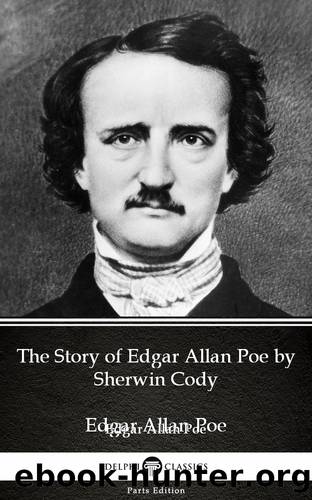
Author:Sherwin Cody [POE, EDGAR ALLAN]
Language: eng
Format: epub
Tags: Parts Edition 18 of 21 by Delphi Classics
Publisher: Delphi Classics (Parts Edition)
Published: 2017-08-25T00:00:00+00:00
CHAPTER X
POE AS A STORY-WRITER
Next to âThe Raven,â Poeâs most famous work is that fascinating story, âThe Gold-Bug,â perhaps the best detective story that was ever written, for it is based on logical principles which are instructive as well as interesting. Poeâs powerful mind was always analyzing and inventing. It is these inventions and discoveries of his which make him famous.
The story of the gold-bug is that of a man who finds a piece of parchment on which is a secret writing telling where Captain Kidd hid his treasure off the coast of South Carolina. The gold-beetle has nothing whatever to do with the real story, and is only introduced to mystify. It is one of the principles of all conjuring tricks to have something to divert the attention. Poeâs detective story is a sort of conjuring trick, but it is all the more interesting because he fully explains it.
Cryptographs are systems of secret writing. The letter e is represented by some strange character, perhaps the figure 8. In âThe Gold-Bugâ t is a semicolon and h is 4, so that; 48 means the. Sometimes the letter e is represented by several signs, any one of which the writer may use; and perhaps the word the, which occurs so often, is represented by a single character, like x. Often, too, the words are run together, so that at first sight you cannot tell where one word begins and another ends.
Solving a cryptograph is like doing a mathematical problem, and Poe was very clever at it.
He published a series of articles on âCryptographyâ or systems of secret writing, in Alexanderâs Weekly Messenger, and challenged any reader to send in a cipher which he could not translate into ordinary language. Hundreds were sent to him, and he solved them all, though it took up a great deal of his time.
In the same line with this was another feat of his. Dickensâs story, âBarnaby Rudge,â was coming out in parts from week to week, as a serial publication. From the first chapters Poe calculated what the outcome of the plot would be, and published it in the Saturday Evening Post. He guessed the story so accurately that Dickens was greatly surprised and asked him if he were the devil.
Again at a later date Poe wrote a remarkable story, âThe Mystery of Marie Roget.â A young girl had been murdered in New York. The newspapers were full of accounts of the crime, but the police could get no clew to the murderers. In Poeâs story he wrote out exactly what happened on the night of the murder, and explained the whole thing, as if he were an expert detective. Afterward, by the confessions of two of the participants, it was proved that his solution of the mystery was almost exactly the truth.
âThe Gold-Bugâ was not published until sometime later, but it was as editor of Grahamâs Magazine that Poe first became known as a writer of detective stories. One of the most famous is âThe Murders of the Rue Morgue.
Download
This site does not store any files on its server. We only index and link to content provided by other sites. Please contact the content providers to delete copyright contents if any and email us, we'll remove relevant links or contents immediately.
Personalized inhaled bacteriophage therapy for treatment of multidrug-resistant Pseudomonas aeruginosa in cystic fibrosis by unknow(212726)
CONSORT 2025 statement: updated guideline for reporting randomized trials by unknow(102510)
Critical evaluation of the ProfiLER-02 study design and outcomes by Vivek Subbiah & Razelle Kurzrock(102036)
Cardiac gene therapy makes a comeback by Oliver J. Müller & Susanne Hille & Anca Kliesow Remes(101829)
Whisky: Malt Whiskies of Scotland (Collins Little Books) by dominic roskrow(74615)
Unveiling the design rules for tunable emission in graphene quantum dots: A high-throughput TDDFT and machine learning perspective by Şener Özönder & Mustafa Coşkun Özdemir & Caner Ünlü(50995)
A yeast-based oral therapeutic delivers immune checkpoint inhibitors to reduce intestinal tumor burden by unknow(40370)
Covalent hitchhikers guide proteins to the nucleus by Alexander F. Russell & Madeline F. Currie & Champak Chatterjee(40294)
Meet the Authors: Christopher R. Mansfield and Emily R. Derbyshire by Christopher R. Mansfield & Emily R. Derbyshire(40202)
Alkaline-earth metals promote propane dehydrogenation with carbon dioxide through geometric effects: Altering the reaction pathway by unknow(32811)
Induced iron vacancies boosting FeOOH loaded on sustainable Fenton-like collagen fiber membrane for efficient removal of emerging contaminants by unknow(32607)
Efficient electric-field-assisted photochemical conversion of methane to n-propanol exclusively over penetrated TiO2Ti hollow fibers by Guanghui Feng(32527)
Bi2SiO5 nanosheets as piezo-photocatalyst for efficient degradation of 2,4-Dichlorophenol by Hangyu Shi & Yifu Li & Lishan Zhang & Guoguan Liu & Qian Zhang & Xuan Ru & Shan Zhong(32463)
A novel NDIPTA organic heterojunction photocatalyst with built-in electric field for efficient hydrogen production by Jiahui Yang & Baojun Ma & Yongfa Zhu(32437)
Enhanced conversion of methane to liquid-phase oxygenates via hollow ferrite nanotube@horseradish peroxidase based photoenzymatic catalysis by Jun Duan & Shiying Fan & Xinyong Li & Shaomin Liu(32401)
Ordered macroporous superstructure of defective carbon adorned with tiny cobalt sulfide for selective electrocatalytic hydrogenation of cinnamaldehyde by Xiao-Shi Yuan & Sheng-Hua Zhou & San-Mei Wang & Wenbo Wei & Xiaofang Li & Xin-Tao Wu & Qi-Long Zhu(32330)
What's Done in Darkness by Kayla Perrin(27244)
Topological analysis of non-conjugated ethylene oxide cored dendrimers decorated with tetraphenylethylene: Insights from degree-based descriptors using the polynomial approach by A Theertha Nair & D Antony Xavier & Annmaria Baby & S Akhila(26627)
Investigation of mechanical and self-healing properties of hydroxyl-terminated polybutadiene functionalized with 2-ureido-4-pyrimidinone by Mohsen Kazazi & Mehran Hayaty & Ali Mousaviazar(26552)
